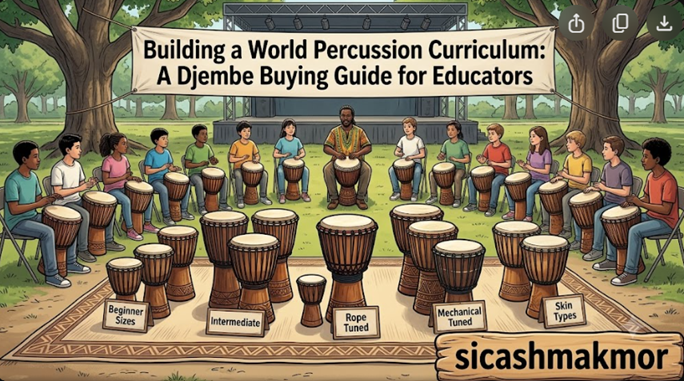
Building a World Percussion Curriculum: A Djembe Buying Guide for Educators
Quick answer: Djembe drums are widely used in school and university world percussion programs because they require no prior musical training, teach rhythm and ensemble skills quickly, and hold up well to repeated classroom use when sourced from a durable, well-constructed batch.
Music departments around the world are expanding beyond conventional band and orchestra instruments to include world percussion, and the djembe is often the first instrument added. It’s approachable for beginners, works well in group settings, and introduces students to rhythmic traditions outside the Western classical canon.
Why Djembe Drums Work Well in Education Settings
- No prior training required — students can produce a usable sound within minutes, unlike many orchestral instruments.
- Built for group learning — djembe ensembles teach timing, listening, and collaboration in a way solo practice cannot.
- Cross-curricular value — many programs pair djembe instruction with lessons on West African history, culture, and the instrument’s origins.
- Scalable for any class size — a single set can serve a small elective or a full ensemble class, depending on how many units are purchased.
What to Look for When Buying Djembe Drums for a Classroom
- Durability over decoration. Classroom instruments are handled by many students; a solid wood shell and reinforced rope tuning matter more than elaborate carving.
- Consistent sizing across the set. A uniform batch keeps sound quality even across an ensemble, which matters for group instruction.
- Reasonable weight and portability. Younger students especially benefit from djembes that are easy to carry and set up.
- Bulk pricing and reorder support. Schools often need to replace or expand sets year over year, so a supplier with consistent stock matters.
- Basic maintenance guidance from the supplier. Rope tuning and drumhead care instructions reduce the number of instruments that fall out of use.
How Many Djembe Drums Does a Program Need?
Class size is the main driver, but most ensemble programs start with one djembe per two to three students to allow rotation during rhythm exercises, then scale toward one-per-student as budget allows. Universities running dedicated world music ensembles often maintain a full set matched to enrollment in that course.
Sourcing Considerations for Education Budgets
Because school and university purchases are often budget-constrained and made through a formal procurement process, buyers benefit from suppliers who can provide:
- Bulk pricing tiers based on order size
- Consistent lead times for the start of an academic term
- Invoicing suited to institutional purchasing (POs, tax-exempt documentation)
- A track record of supplying other educational institutions
Conclusion
A well-chosen set of djembe drums can anchor a world percussion program for years, provided the instruments are durable, consistently made, and sourced from a supplier familiar with the needs of educational buyers. For music educators building or expanding a program, prioritizing construction quality and reliable bulk supply will matter more in the long run than decorative detail.
